For most of its history, investment migration has been a strategy pursued by clients from emerging markets: families seeking stronger passports, better travel access and a degree of security that citizens of more established nations had long taken for granted. American families had little reason to engage with the question.
That has changed. Inquiries from American clients to leading advisory firms have increased by approximately 1,000% over five years. The motivation, more often than not, is not emigration; it’s optionality: the recognition that relying on a single country as one’s only option is itself a form of risk.
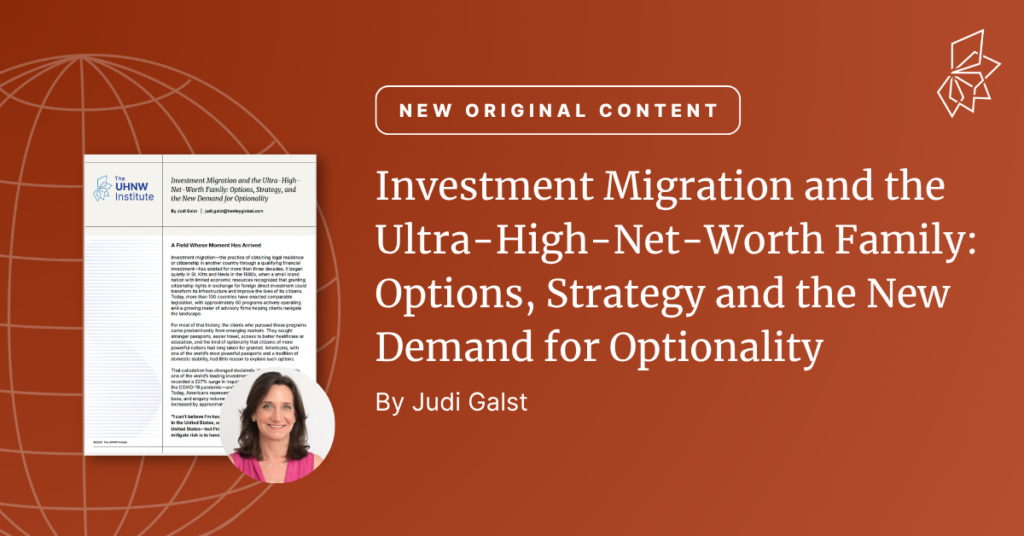
A new white paper from The UHNW Institute, by Judi Galst (Managing Director, Private Clients at Henley & Partners), examines why wealthy American families are pursuing alternative residency and citizenship now and what a well-considered approach to investment migration looks like for families with multi-jurisdictional wealth arrangements.
The paper addresses:
- The critical distinction between residence by investment and citizenship by investment and why it matters for long-term planning
- The programs attracting the most interest from American clients, from Caribbean citizenship to European residency to New Zealand’s tiered investment structure
- How applications are structured for families whose wealth spans personal accounts, trusts, holding companies and family offices
- The tax realities that advisors and clients most frequently misread
- The multi-generational dimension: planning for children, grandchildren and family members not yet born
For family offices, wealth managers and estate planning attorneys, investment migration is no longer a peripheral concern. It belongs in the same conversation as succession planning, asset allocation and long-term estate strategy.
Read the full paper here.