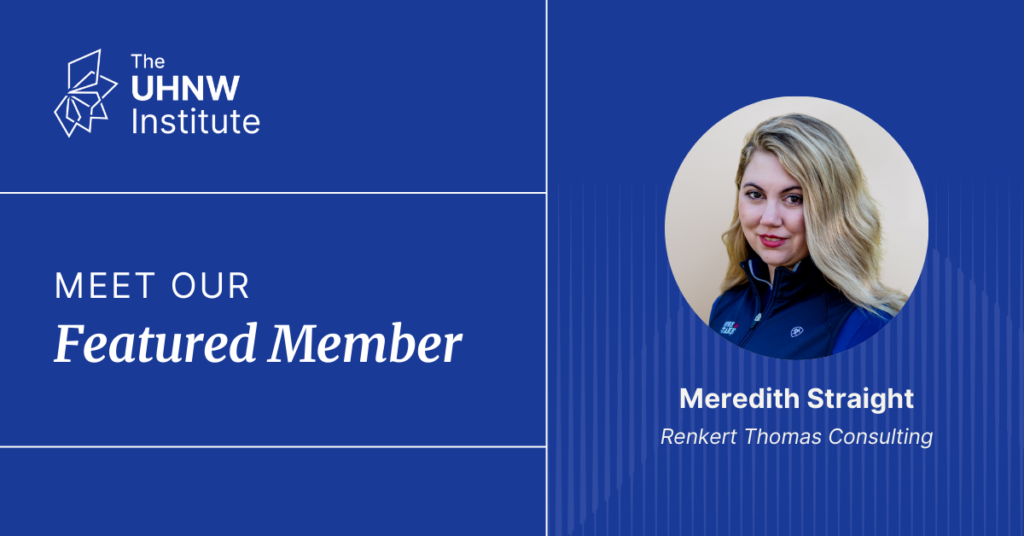
This month, the Institute spotlights our quarterly conversation with Meredith Straight of Renkert Thomas Consulting.
Meredith speaks to the importance of staying connected to a values-aligned professional community. She offers perspective for younger professionals entering the field, shares how her earlier career in emergency and pediatric critical care continues to shape her approach to supporting families, and previews her forthcoming paper with Institute faculty, A Blueprint for Multi-Generational Success: Building a Coalition of the Willing.
Why did you join the Institute?·
I have the great privilege of working with families with my family everyday—I co-own andoperate Renkert Thomas Consulting with my mom, Amelia Renkert-Thomas. We are a small team and like it that way—it provides us a great deal of flexibility in taking clients where we think we can make an impact, balancing client work and thought leadership, and prioritizing other important components of our lives. I do think, though, that this work cannot be done well in solitude. Whether that is pushing on our thinking in various areas or finding better fits when we are not the right team to serve a client’s needs, being part of a community with aligned values that is constantly working to push the industry to grow in the right direction is invaluable. I greatly enjoy that I am both able to contribute and learn here, surrounded by a group of such talent and thoughtfulness eager to do the same.
What’s your best advice to an emerging professional entering the field now?
I have found it to be a fundamental truth of being a younger professional in this space that I am far less lonely than I once may have thought, and yet the industry continues to need younger voices to both further the work of our more seasoned colleagues and to ensure that we as an industry are meeting the needs of this generation of rising generation clients. There are elements of that experience that are relatively stable through time, but today’s unique mix of economic and cultural forces must be accounted for as well. So much expertise is built over the course of a career, but there is specific knowledge that emerging professionals can bring today. Joining a variety of conversations and entering spaces that you find engaging can provide a real impact—seek out those opportunities early and often.
Share one fun or interesting fact about yourself that few people know.
I spent the first three years of my career as an Emergency Room and Pediatric ICU nurse. While my first degree was in Learning and Organizational Change, I developed a deep interest in healthcare and healthcare policy work through an internship I did after my freshman year. While I didn’t stay, the lessons I learned during that time inform so much of the work I do today. How do we as advisors care for families through their highs and lows with deep respect for their choices? If a multitude of problems need to be solved, how do we triage what to attack first? What are the risks of policy proliferation in a system unequipped to reliably follow those policies? (This last one is one of my favorite questions both then and now). I remember being so fearful early in my career pivot to openly discuss this time, that it would be less impressive or would make me appear ill-prepared for the work I was doing, but so much of it I rely on regularly. I’ve even come across another colleague who spent time as an RN—our conversations about our past and its applicability to what we do today are some of my favorites.
You have an upcoming paper, co-authored with fellow Institute faculty, A Blueprint for Multi-Generational Success: Building a Coalition of the Willing. What are 1-3 to three core takeaways you believe are most important for readers to understand or apply?
There is a societal script about the denominator effect—”a new generation means more mouths to feed”. The economic realities of a broadening ownership base certainly need to be considered, but one of the topics I loved discussing most with my co-authors was the optionality that this growing human capital base provides. So often, among our clients, the reaction to succession is, “How do I replace this key person?” But as families grow, one-to-one substitution becomes less critical. Yes, shoring up critical talent and skills is important, but the conversation can become, “How do we elevate a group of individuals who together bring the talent and skills we need to make this system thrive?” Additionally, as multiple spheres, domains, or rooms of governance are built out, tapping new kinds of talent and skills can be extremely valuable—a family council chair needs a different skillset than a board member—but both are critical to the family’s success. An MBA isn’t the only path to making a difference.
We discuss an alternative to the baton pass—adding new governance seats without requiring the current generation to step aside. A multigenerational coalition provides so many opportunities for a wider set of views, a deep human capital pool, and learning up, down, and across generations. Succession doesn’t have to be a brief moment; it can be an ever-ongoing practice that lets family members bring their gifts as they are able and work together to achieve what is most important to them.
The Institute’s theme this year is around stories that move the industry forward. What is one important perspective/voice that you think should be considered this year to help move the industry forward?
Jim Grubman’s “Strangers in Paradise” has always been one of my favorite books in this space. Over the past year, I’ve met a number of rising gens who embody this story both in the metaphor Jim uses and its literal sense—the children of immigrant wealth builders who as young adults are navigating both the second generation of wealth and the second generation as Americans. As the UHNW space evolves to be more multicultural, this set of voices both speak to a specific need and broader truths that apply to many of the families we as an industry serve.