Dear UHNW Institute Members,
Spring is in full swing at the Institute this month, and we’re excited to launch the registration for our second annual Women’s Leadership Summit on June 10 and 11 in Palm Beach, Florida. We’re gearing up for another memorable event, filled with expert-led panels, thought-provoking workshops, networking, and connection.
Our programming, events, and content this month will focus on talent development. The Institute will be recognizing ways to support the talent within our member firms and families with a Virtual Collegium: Human Capital: Competing Forces: The Challenge of Delivering Integrated Advice in the Era of AI, open to all members on April 23. And lastly, we’re ramping up our new Emerging Leaders & Next Gen Initiative to better support talent development of member firms and families through coaching and mentorship. We invite you to share ways you’re developing tomorrow’s leaders within your own firms and how families are thinking about talent, including preparing inheritors for stewardship.
The Implications for the UHNW Ecosystem
In the UHNW environment, the greatest risk is not a lack of talent—it is a failure to evolve how it is developed. And with that in mind, our programming, events, and content this month will focus on talent development.
The firms and families that will lead the next era are not those with the most experience—but those with the most adaptive learning systems.
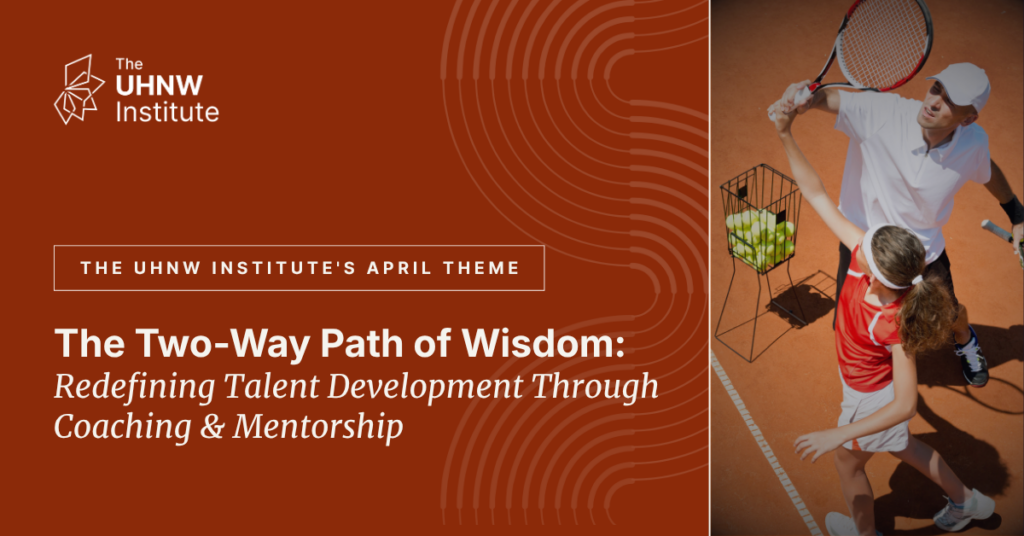
The Two-Way Path of Wisdom is not simply about development—it is about continuity, relevance, and resilience. It strengthens succession, deepens trust across generations, and prepares leaders for complexity, not just competence.
A Shift in How Wisdom Flows
For decades, talent development in wealth management firms and UHNW family enterprises followed a predictable arc: Experience flowed downward. Senior leaders mentored emerging professionals. Knowledge was transferred. Continuity was preserved.
That model is no longer sufficient. Today’s most effective firms—and the most resilient UHNW families—are embracing a more dynamic paradigm: Wisdom is no longer linear; it is reciprocal. The future of leadership development lies in a two-way path, where coaching and mentorship intersect to create a continuous exchange of insight, perspective, and growth across generations.
This evolution is not philosophical—it is strategic.
Coaching vs. Mentorship: A Critical Distinction
Understanding the difference between coaching and mentorship is foundational to building modern talent systems.
Coaching: Structured, Performance-Oriented Growth
Coaching is intentional, often time-bound, and designed to unlock specific capabilities.
- Focus: Performance, decision-making, behavioral change
- Relationship: Objective, often external or professionally trained
- Method: Inquiry-based, forward-looking, accountability-driven
- Outcome: Measurable improvement and leadership capability acceleration
In UHNW advisory firms, coaching is increasingly used to prepare next-gen partners for equity roles, develop leadership presence in client-facing advisors, and navigate complex family dynamics with neutrality and clarity.
Mentorship: Experiential, Relational Wisdom
Mentorship is relational and evolves over time. It transmits judgment, context, and lived experience.
- Focus: Career navigation, identity, stewardship
- Relationship: Trust-based, often internal or long-term
- Method: Storytelling, modeling, guidance
- Outcome: Pattern recognition, values alignment, institutional memory
Within UHNW families, mentorship plays a critical role in preparing inheritors for stewardship—not just ownership, transferring family values alongside financial capital and supporting identity formation in next-generation leaders.
Additionally, a defining shift in emerging leader development is the move from hierarchical mentorship to reciprocal mentorship. This model recognizes that emerging leaders bring digital fluency, cultural awareness, and new mental models, while senior leaders may bring experience, judgment, and institutional insight. When structured intentionally, mentorship becomes bi-directional, dynamic, and continuously evolving.
Where the Real Power Lies: The Intersection
The most sophisticated organizations are not choosing between coaching and mentorship—they are integrating them. This is where the Two-Way Path of Wisdom emerges. Coaching provides structure and velocity, while mentorship provides depth and continuity. Together, they create adaptive, multi-generational leadership systems.
How Career Development Evolves
When mentorship becomes reciprocal, career development transforms in three meaningful ways:
- Identity Becomes Co-Created. Emerging leaders are no longer “shaped” by senior leaders—they actively participate in defining leadership norms, culture, and client experience.
- Leadership Readiness Accelerates. Exposure to real-time dialogue with senior decision-makers builds confidence, pattern recognition, and judgment faster than traditional training models.
- Organizations Become Learning Systems. Firms and families evolve from knowledge hierarchies into adaptive ecosystems—where learning is continuous, shared, and embedded.
A 10-Step Blueprint for Building a Two-Way Talent System
To operationalize this model within your firm or family enterprise:
- Define Distinct Roles
- Clarify when an individual is acting as a coach vs. a mentor—and when both are needed.
- Build Dual-Track Development
- Create parallel systems:
- Coaching (structured, measurable)
- Mentorship (relational, evolving)
- Introduce Reciprocal Mentorship Pairings
- Deliberately match senior leaders with emerging leaders for bi-directional learning.
- Train Mentors and Mentees
- Teach both parties how to engage in inquiry, listening, and co-development—not just advice-giving.
- Incorporate External Coaches
- Use neutral third-party coaches for sensitive leadership, governance, or family dynamic issues.
- Embed in Succession Planning
- Tie coaching and mentorship directly to leadership transition pathways—both in firms and families.
- Create Peer Learning Cohorts
- Facilitate small, trusted groups where emerging leaders learn from each other—not just senior figures.
- Measure What Matters
- Track outcomes such as:
- Leadership readiness
- Retention of emerging leaders
- Decision-making confidence
- Intergenerational alignment
- Normalize Role Fluidity
- Encourage leaders at all levels to be both teacher and learner—simultaneously.
- Align with Purpose and Identity
- Ensure all development efforts connect to firm vision, family values, and individual purpose.
- Track outcomes such as:
- Create parallel systems:
Be sure to explore the following UHNW Institute Resource Library resources to support this month’s theme, The Two-Way Path of Wisdom, and join us for our monthly programming, including the Virtual Collegium on April 23rd.
ARTICLES
WHITEPAPER | FUNDAMENTAL
Growing from Analyst to Partner: Investing in the Human Capital Within Your Organization
Kristin Keffeler, The UHNW Institute. 2026
This report summarizes the Institute’s Practice Management Clinic held virtually in March 2026. The session examines both the opportunities and practical challenges of developing human capital. It situates advisor development and integrated practices within the broader Wealth 3.0 framework, highlighting the need for training that goes beyond technical expertise to include communication, emotional intelligence, and cross-domain collaboration. The discussion underscores human capital development as a consistent and deliberate priority embedded in the firm’s culture, rather than an incidental outcome.
ARTICLE | ADVANCED
The Benefits of Coaching for Family Enterprise Leaders and Practitioners
Greg McCann, FFI Practitioner, Weekly Edition. 2020
Family business consultant Greg McCann discusses widely held notions about professional coaching and how family enterprise leaders and advisors can maximize their leadership development through effective coaching.
ARTICLE | FUNDAMENTAL
Scaling AI Across Talent Management in Financial Services Organizations
Neda Shemluck, Alison Rogish, Samia Hazuria, Jim Eckenrode, and Patty Danielecki, Deloitte Center for Financial Services. 2025
Leaders from large US firms say implementations in talent have been limited so far. How can firms overcome barriers to realize the benefits an AI-enabled talent experience could bring?
BOOK | FUNDAMENTAL
Self As Coach, Self as Leader: Developing the Best in You to Develop the Best in Others
Pamela McLean, Wiley. 2019
Pamela McLean, CEO and co-founder of the Hudson Institute for Coaching, teaches readers to cultivate their leadership potential through the “use of self as an instrument,” a key dimension of developmental coaching that emphasizes the whole person. Her holistic methods give coaches and other leaders a clearer framework for getting to know themselves, exploring their multiple layers, and fostering their latent abilities so they can foster the abilities of others.
—
PODCASTS
PODCAST | FUNDAMENTAL
Mentorship for Rising Gen Readiness – Podcast
Kirby Rosplock, Paul Edelman, Tamarind Learning. 2023
This podcast explores the evolving role of mentoring in preparing Rising Generations for leadership and other responsibilities in families and family enterprises. The discussion highlights mentoring not only as a relationship between individuals but also within groups and across cultural settings. Listeners will gain insight into how mentorship can accelerate development and address the complex learning demands facing Rising Gen family members. The episode also examines reverse mentoring, where younger generations guide their elders.
—
VIDEO
VIDEO | ADVANCED
Talent in 2030: The Core Challenge
The UHNW Institute. 2022
From The UHNW Institute’s 2022 Symposium: A Roadmap to 2030 – Serving the 100-Year, Multigenerational, Evolving Family with Excellence. This final session of the Symposium was a panel where several senior industry professionals spoke about the difficult role of talent management within the wealth industry. They identified the key elements of having new skills, the “3 Q’s” (IQ, EQ, MQ), attracting diverse advisors, and maintaining engagement and development of the best advisors. Other comments addressed how advisors and firms will adapt to the talent challenges now and in the future, plus trends among family offices and their leadership.
VIDEO | FUNDAMENTAL
Emerging Leaders Cohort & Mentorship Program
Alexa Steriti Carbone, Lisa Friedman, Lisa Sivolella, and Angelique LeDoux, The UHNW Institute. 2025
In this webinar, an expert panel provides strategies to deliver successful mentorship programs for organizations and individuals. Mentors and mentees each play a vital role in the program’s outcomes. The panelists present various approaches, including formal and informal relationships, reverse mentoring, and lateral mentor relationships that enhance the breadth of skills. Participants from the UHNW Institute’s Mentorship Cohort program offer insights based on their experiences.
—