A family can have excellent investment, tax, estate planning and governance advisors and still be left with a surprisingly difficult question: How does all of this fit together?
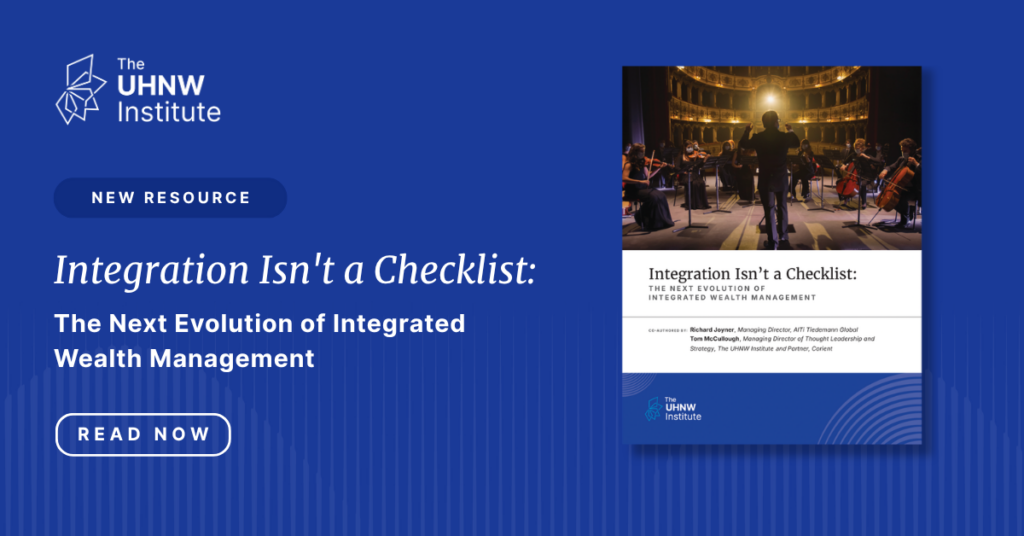
That is the challenge at the heart of Integration Isn’t a Checklist: The Next Evolution of Integrated Wealth Management, a new white paper from The UHNW Institute, co-authored by Richard Joyner and Tom McCullough.
Drawing on decades of work with wealthy families, Joyner and McCullough argue that the wealth management profession has become exceptionally good at assembling specialists, but that breadth of expertise is not the same as integration. Families do not experience their lives as a series of separate investment, tax, estate or governance issues. They experience decisions, and those decisions often cut across several disciplines at once.
The paper explores what it takes to move from coordination to true integration. It examines the role of the integrated advisor in weighing competing priorities, connecting technical recommendations to a family’s goals and circumstances, and helping families see the whole picture. Examples involving business succession, shared family property and support for adult children show why technically excellent advice can still fall short when the pieces are considered separately.
The paper also looks at what integration requires of advisory firms themselves. Culture, shared responsibility, sufficient time for the often invisible work that happens before a client meeting, the economics of experienced judgment, and the deliberate development of the next generation of integrated advisors all play a role.
The central message is simple: integration is not about having more boxes on the checklist. It is about making all the pieces work together so families can make better decisions.
Members can read the full white paper in the Resource Library.